


Pearson PLC
10 weeks
Discovery · Strategy · Concepting
Discovery Lead
Business Analyst
Envisioning stream
Exp. Consultant
Key Designer (me)
Delivery stream
Exp. Consultant
Key Designer
As a Key Designer of Envisioning Stream, I was responsible for developing the design concepts.
Pearson's Virtual Schools platform for US students — an online learning environment used by thousands of K12 learners.
Pearson had years of research, surveys, and analytics, but no clear vision for how to evolve their career readiness program. The data existed, the strategy didn't.
Together with the experience consultant we synthesized existing research and competitive landscape into an experience matrix, and shaped 53 raw ideas into 4 focused strategic concepts, each with visual design direction and a roadmap.
Pearson aligned on a strategic direction and extended the project to Phase 2 (user research and validation of the concepts). The work laid the foundation for what became Career Explorer, now a key differentiator in Pearson's career readiness offering.
Pearson is one of the world's largest education companies, and their K12 Virtual Schools platform reaches thousands of students across the US. But despite the scale, their Career Readiness program had a problem: it existed, but it didn't quite work. Students weren't engaging. The experience felt fragmented. And no one had a clear picture of where it should go next.
That's where our team came in.
We were brought in as a cross-functional consulting team to help Pearson find a direction. From the start, we split into two parallel streams: a Delivery stream, focused on near-term improvements, and an Envisioning stream, where I worked, focused on a longer-term strategic vision. My role as Key Designer meant I was responsible for shaping how that vision would actually look and feel.
Pearson didn't come to us empty-handed. They came with years of accumulated material: survey results, interview findings, user personas, and a trail of conference slides documenting where the program had been. The challenge wasn't a lack of information. It was that no one had connected the dots yet.
So, that became our first job.
We ran a fast but thorough desk research phase, pulling together everything Pearson had and filling in the gaps with our own competitive research and web analytics. But instead of producing a standard research report that would sit in a shared drive, we channeled everything into a living artifact: an Experience Matrix.

We mapped the student, teacher, and caretaker journeys across all touchpoints, then layered in insights from the desk research, competitive landscape, and analytics data. The result was a single, structured view of the entire career readiness experience. We also built out three separate Customer Journey Maps by role, because the experience looked very different depending on who you were.
While the matrix was taking shape, we were also running stakeholder interviews in parallel. Due to a significant time zone difference, I wasn't able to join the live sessions, but I was actively involved in processing and synthesizing the findings.


What came out of those conversations was invaluable: real business goals, honest pain points, and a clearer picture of what Pearson's internal stakeholders actually believed in, and where they disagreed. We mapped all of that directly into the Experience Matrix, so by the end of the discovery phase, we had one unified source of truth that held both the user perspective and the business perspective.
With a solid foundation in place, we moved into ideation, and this is where things got exciting. It was also one of the most challenging parts of the project, not because ideas were hard to come by, but because there were too many good ones to choose from.
We ran a collaborative ideation workshop with stakeholders, generating a wide range of ideas for how career readiness could be reimagined.

After voting and initial clustering, we had 53 solution cards, each capturing a distinct idea with key attributes and features.

The first down-selection workshop was meant to narrow the field. But it didn't quite go as planned, in the best way. People loved too many ideas, and the group couldn't agree on a meaningful cut.
So we went back, redesigned the workshop format, and ran a second round with a stricter voting structure that forced real prioritization. That's how we arrived at our top 16 ideas, for each of which we developed a value proposition, articulating the core student benefit, potential KPIs, and a rough wireframe to make it tangible.
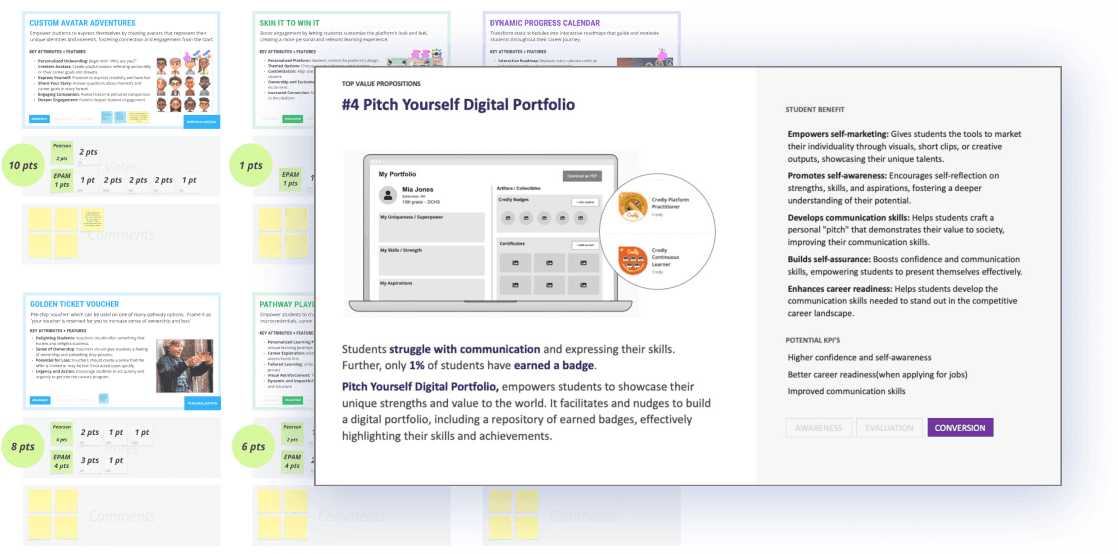
We presented the value propositions to stakeholders and gathered feedback, getting a clearer sense of which values resonated most. After clustering and consolidating the strongest ones, we landed on 6 conceptual directions. Two were set aside because parallel efforts elsewhere in the organization were already covering that ground. That left us with 4 concepts to develop fully.

Each of the four concepts addressed a distinct student challenge, and was a self-contained vision for a different aspect of career readiness. For each, we developed storyboards and concept designs to bring the ideas to life visually, not polished UI, but enough to communicate the experience and spark a real conversation.
This concept tackled the barrier to entry. Instead of asking students to commit to long-form content, it offered bite-sized, swipeable career interactions, think Duolingo meets Tinder, with an AI-powered payoff: periodic insights that showed students patterns in their own choices, like a Spotify Wrapped for self-discovery.

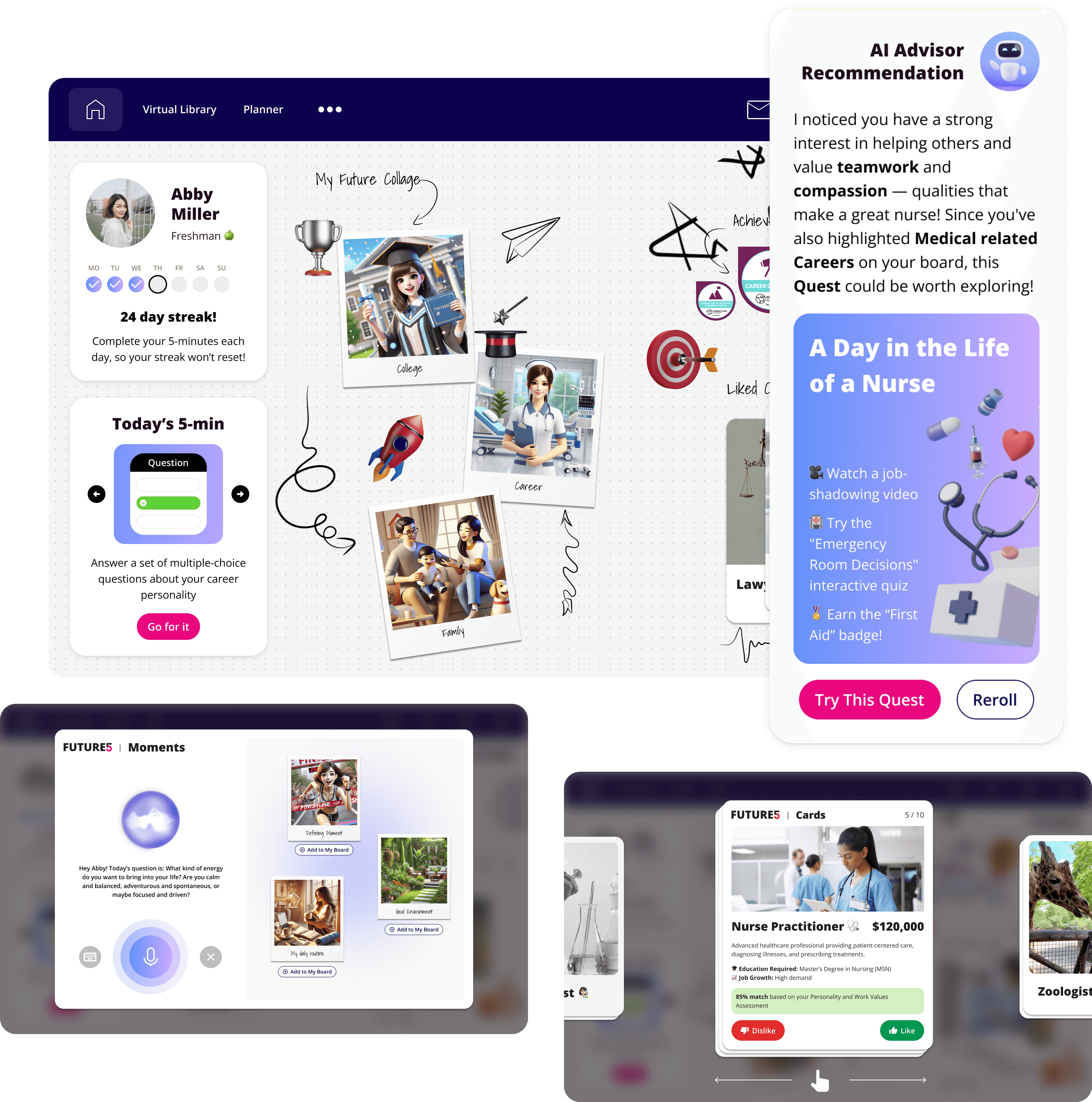
Here we tried to bring structure and motivation through gamification. Students would build a personal avatar, jump into a career "quest," and follow a visual map of content unlocking along the way. Social mechanics, group challenges and shared achievements, made it sticky. The idea was to make career exploration feel like a game worth playing.


This one was the most personalized of the four. Driven by assessment data, this concept gave each student a unique, evolving map of possible career paths, overlaid with specific milestones and deadlines, so nothing important gets missed. Whenever a student feels stuck, an AI coach or a real career advisor is just one click away. The whole thing could also be shared, giving teachers and parents a window into the student's thinking.


Addressing the other end of the journey, this concept combined an auto-populated digital portfolio tool, AI-assisted video production, and mock interview coaching, giving Pearson students a tangible edge when it was time to pursue a career for real.


We presented all four concepts in a final demo, alongside a strategic framework, a backcasting roadmap that mapped the path from today's platform to the envisioned future in three time horizons: near-term, mid-term, and lighthouse.

Pearson agreed. The project was extended into Phase 2, focused on validating the concepts with US-based students through user research. With such a significant time zone difference, participating in that phase wasn't realistic, so I stepped off the team at that point.
But the work we did in Phase 1 clearly left a mark. The thinking we developed became the foundation for Career Explorer (see video), Pearson's new career readiness product, now live and positioned as one of the key differentiators in their K12 offering.
It's a particular kind of satisfaction, seeing an idea you helped sketch out in a workshop become something students actually use.
Back