


EPAM
Eduverse
5 months
UX/UI design · Motion · Conversational design · Prototyping
Design Lead (me)
Middle Designer
Developers
As a Design Lead for Eduverse, I led design direction for Learn and worked hands-on on the AI voice experience.
The flagship product of EPAM’s Eduverse ecosystem, a learning platform for employees, students, and external partners.
A new AI model enabled real-time, interruptible dialogue, but the old UX was still built around rigid turn-taking and explicit state cues.
I reframed the interaction around a more natural conversational flow, using motion, onboarding, and a responsive orb to replace step-by-step system signaling with a more natural sense of presence.
The concept moved into production. User feedback validated the shift toward a more natural sense of presence. The AI conversation simulations later won a Silver Stevie® Award.
The Learn platform is a place where people come to grow: courses, certifications, mentoring, and skill tracking all in one place. As part of the Eduverse ecosystem, it serves over 50,000 people across dozens of countries, including EPAM employees, students, and external partners.
The AI conversation simulator was a priority initiative that powered AI agents to conduct natural conversations and assess learner skills. It was actively used for English level assessments and was expanding to other skill domains. The technology worked, but talking to it still felt like filling out a form with your voice.
The original simulator was built around the constraints of early voice AI: strict turn-taking, explicit cues for when to speak and when to stop, a processing pause, then the agent's response. The interface made every step visible, and the experience felt like a protocol, not a conversation. "Your turn. Speak now. Stop. Wait. Agent speaking. Stay silent."


As the product prepared to switch to a new underlying AI model, it became immediately clear that the existing UX would no longer be enough. The new model would support real-time understanding, natural interruptions, and more genuine back-and-forth dialogue. Keeping the old interface would have wasted the opportunity entirely.
So, I decided to take ownership of the redesign, because the change was not just visual. It required rethinking the interaction model itself, from a system of rigid turns to something that felt closer to actual speech.
I didn't start with the interface. I started with a question: what makes AI feel alive to people?
Sci-fi exploration gave me the user's expectations. HAL 9000, Jarvis, Her, GLaDOS, decades of cultural references have shaped what people intuitively sense when talking to an AI. The common thread across all of them: the AI is never static. Presence is communicated through constant, subtle movement.

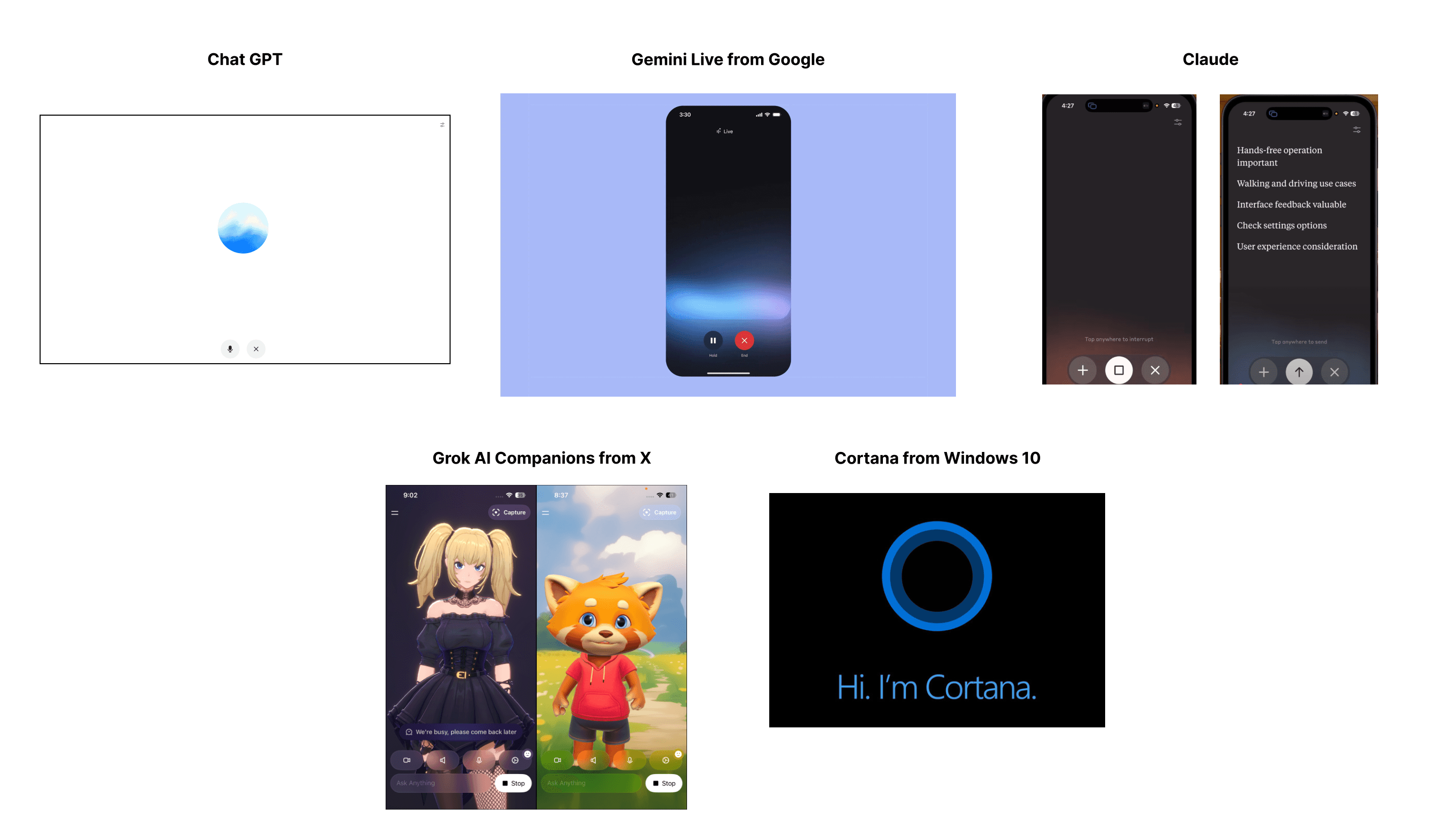
Real products showed the design patterns. ChatGPT's voice mode, Gemini Live, Cortana, Claude, Grok — each handles real-time audio differently. Some go avatar-first, some stay minimal. But the insight across all of them was the same: state transitions drive the feeling of realness, not visual complexity. The cleaner and more organic the feedback, the more natural the experience feels.
This gave me a direction: don't add more interface. Let the agent be there instead of announcing what it's doing.
I wanted the main visual to feel organic and responsive, but not human-like. A humanoid avatar risked giving users the uncanny valley feeling, which would have made the whole thing even less comfortable. So, I landed on an animated orb. It could feel alive without pretending to be a person.
The core of this solution was an audio-driven sense of presence, where the sphere feels like it is speaking and listening because its movement is tied directly to the voice wave. When the agent spoke, the motion expanded outward. When the user spoke, it moved inward, demonstrating a kind of “active listening”. That made the interaction feel intuitive at a gut level instead of forcing people to read explicit system states.
To strengthen the sense of presence, I introduced the orb from the very first onboarding step, so it didn’t just appear once the conversation started. It began in a quiet standby mode while users reviewed the rules. Then it seamlessly moved to guiding them through the flow, helping to set up mic and camera. This way the transition into conversation felt continuous and by the time the actual dialogue began, the orb was already part of the interaction.
The prototype was pitched to stakeholders and moved into development. To fully bring the idea to life, I animated each state in Rive. However, the audio-reactive part had to happen at the code level, so I worked closely with the developers to fine-tune the timing and level of the response to sound. We kept adjusting until the motion felt right.
We rolled it out as a soft launch with admins and course creators to validate the new experience with a limited group of real users before going wide. The feedback was reassuring: people said it "felt like a real conversation" compared to the old, robotic agent, with no major UX friction along the way. That confirmed we'd landed the shift we were aiming for.
The AI conversation simulations were quickly adopted across skill competency centers within the company, and the approach soon extended beyond Learn into client-facing projects within the EdTech space.
The work was later honored with a Stevie® award — external validation that the voice interaction approach we built helped unlock the full potential of the technology in learning and skills assessment.

AI in Learning and Skills Development Achievement
SILVER STEVIE® WINNER
EPAM Systems, Newtown, Pennsylvania, United States: Empowering Talent through AI-Enhanced Language Assessment
Back